Using this Compound Interest Calculator
This calculator helps you understand how your money grows when interest is added not just to your initial amount, but also to the interest already earned. Instead of guessing future returns, you can get a clear estimate within seconds.
To use it effectively, start by entering your initial amount. Then add the annual interest rate and the number of years you plan to invest or save. If the tool allows, you can also select how often the interest is compounded, such as annually, monthly, or daily. If you're planning to contribute regularly, enter your additional deposits and choose how frequently you'll add them. This gives you a more realistic picture of how your savings or investments will grow over time.
This tool is useful for:
- Planning long-term savings goals
- Comparing different interest rates
- Understanding the impact of time on investments
- Testing different contribution strategies
What is Compound Interest?
Compound interest is the process where your money earns interest, and then that interest starts earning interest too. Instead of growth happening in a straight line, it accelerates over time.
Think of it as a snowball effect. In the beginning, growth feels slow because interest is calculated on a smaller amount. But as time passes, the accumulated interest increases your total balance, which leads to even higher interest in the future. This is why compound interest is often considered one of the most powerful concepts in finance. It rewards consistency and patience, making it especially valuable for long-term saving and investing.
How to Calculate your Compound Interest
Calculating compound interest manually may seem complicated at first, but it becomes easier once you understand the core idea. You need four main inputs:
- Your starting amount
- The interest rate
- The time period
- How often the interest is compounded
Instead of calculating each step yourself, the calculator handles this instantly. You just input your values, and it shows your final balance along with the total interest earned.
If you want to experiment, try adjusting one variable at a time. Increase the time period or the interest rate and notice how significantly your final amount changes. This helps you understand which factors have the biggest impact on growth.
How to Use This Compound Interest Calculator
To use this calculator, you need to follow these simple steps:
Enter your initial deposit
Start by adding the amount you're investing today to set your base.
Select your years of growth
Choose how long you want your money to stay invested to see the long-term impact.
Add your estimated rate of return
Input the expected annual return to calculate realistic growth.
Choose compound frequency
Select how often interest should be applied, such as monthly or yearly.
Review your results
Adjust values and test different scenarios to understand how each factor affects your final returns.
This calculator provides estimates and should not be considered financial advice. Actual returns may vary.
Compound Interest Formula
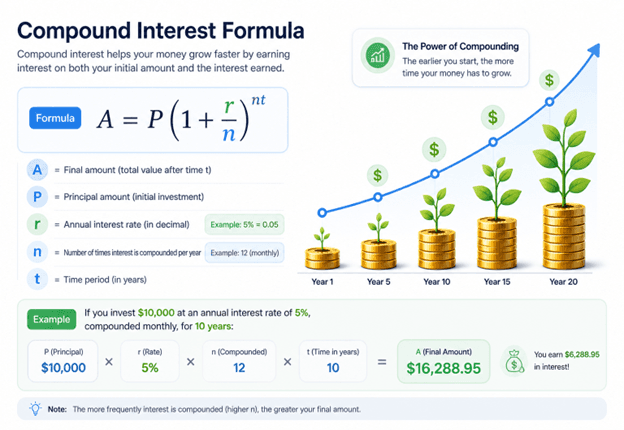
At its core, compound interest is calculated using a standard formula:
- A — Final amount (principal + interest)
- P — Principal (initial investment)
- r — Annual interest rate as a decimal (e.g., 5% = 0.05)
- n — Number of times interest is compounded per year
- t — Time in years
Interest Calculator Example
Let's say you want to see how your savings will grow. Enter an initial amount of $5,000, an interest rate of 6%, and a time period of 8 years. After entering these values into the calculator, you'll instantly see your total balance along with the interest earned.
Now try changing the years from 8 to 15. You'll notice that the increase in total amount is not linear. The growth becomes much faster over time because of compounding.
This kind of testing helps you make better financial decisions. Instead of relying on assumptions, you can clearly see how different scenarios play out.
Compounding With Regular Contributions
While compound interest alone can grow your money, combining it with consistent contributions creates much stronger results. Small, regular deposits can significantly increase your final balance over time.
For example, imagine you start with $10,000 at an annual interest rate of 4% and leave it untouched for 10 years. You'll earn a decent amount of interest, but the growth remains limited to your initial investment. Now consider adding a fixed contribution every month. Even a modest amount like $100 can make a noticeable difference. Over time, each contribution starts earning interest, and that interest compounds just like your original investment.
This creates a layered effect where multiple deposits are growing simultaneously. As the years pass, the combined impact becomes much more powerful than relying on a single lump sum.
It's important to understand that consistency matters more than the size of contributions. Regular deposits, even if small, can outperform irregular larger deposits because they stay invested longer and benefit more from compounding.
Another key factor is compounding frequency. The more often interest is applied, the faster your money grows. Daily or monthly compounding will generally produce better results than annual compounding, assuming the same rate.
Also note that financial institutions may present returns differently. Some use annual percentage yield (APY), which already includes the effect of compounding, while calculators typically require the nominal interest rate. Understanding this difference ensures you're entering accurate values.
Compounding Investment Returns
Compound interest is not limited to savings accounts. It plays a major role in investments such as stocks, mutual funds, and retirement accounts. When you invest, your returns may come in the form of interest, dividends, or capital gains. If those earnings are reinvested instead of withdrawn, they also begin to generate returns.
Over long periods, this reinvestment can significantly increase your overall wealth. This is why early investing is often emphasized. The more time your money has to compound, the greater the potential growth. Even small delays can reduce the final outcome because you lose valuable compounding periods.
Starting early, staying consistent, and reinvesting returns are key strategies for maximizing compound growth.
Frequently Asked Questions
Switch between monthly and annual compounding to see how more frequent compounding slightly boosts long-term growth. While the difference may seem small in the short term, it compounds into a meaningful amount over many years, especially with larger balances.
Compare both by removing contributions vs adding them to see how consistency impacts your final balance. Regular monthly contributions often outperform a single lump sum because each deposit has time to compound. Consistency and time in the market are key drivers of growth.
This happens because compounding builds over time, with larger gains appearing in later years. In the early stages, interest is calculated on a smaller base. As interest accumulates and is reinvested, it starts generating its own interest — creating an accelerating growth curve.
Run a lower return scenario to roughly account for inflation and get a more realistic projection. For example, if your expected return is 7% and inflation runs at 3%, using 4% as your real rate of return gives a more accurate picture of your purchasing power over time.
Use the results as estimates, not guarantees, since actual returns can vary based on market conditions. This calculator assumes a fixed interest rate over the entire period, which is ideal for savings accounts or fixed-rate bonds but may differ from variable-rate investments such as stocks or mutual funds.
See Compound Interest Work for You
Enter your numbers and explore the Yearly Breakdown and Rate Comparison to find the investment strategy that works best for your goals.